Why Classical Education Cares as Much About Character as Knowledge
October 6, 2026
A child can memorize a fact, solve an equation, write a strong essay, or earn an impressive grade. While those things matter, we often wonder what happens when that same child has to decide what is true, respond to someone who disagrees, persevere through something difficult, or choose what is right when no one is watching. Education has an opportunity to prepare students for those moments, too.
That is one of the reasons classical education cares so deeply about character. At Archē Classical Academy, education is about who that student is becoming as much as what the student knows.
Education Shapes More Than the Mind
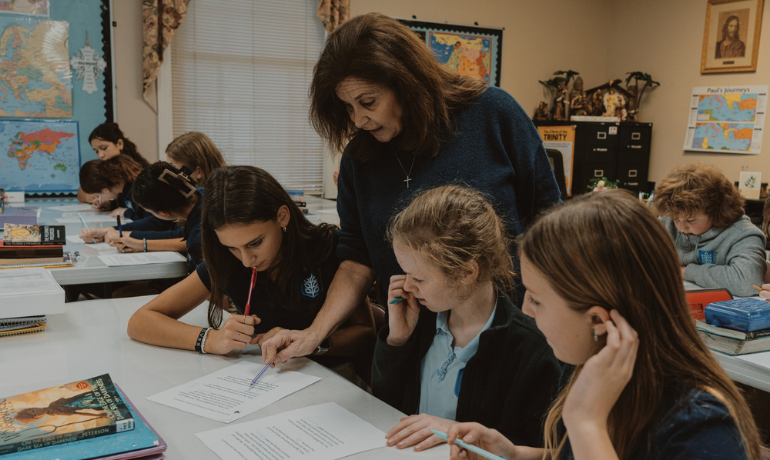
School is a place where students develop habits that stay with them long after they leave the classroom. They learn how to approach a difficult problem, listen to someone with a different perspective, respond when they make a mistake, persevere when something feels hard, and consider what is worth pursuing. Those lessons take shape through daily classroom experiences, relationships with teachers and classmates, and the expectations that guide school life.
Classical education makes room for those lessons alongside the study of great ideas, important texts, history, mathematics, science, and the arts.
Rather than treating character formation as a separate lesson that happens occasionally, the classical model recognizes that education should help students grow in wisdom, virtue, and the ability to think well. Students encounter ideas, stories, historical figures, literature, and questions that give them opportunities to consider not only “What happened?” or “What do I know?” but also “What is good? What is true? What is beautiful?”
At Archē, those questions are grounded in the Christian faith. The school believes Christ is the authority over every area of life, so faith is integrated into the educational experience rather than reserved for a particular class or part of the school day.
Growing in Knowledge and Wisdom
A well-educated person needs knowledge. Students need to know history, mathematics, science, literature, language, and the many other subjects that help them understand the world. But knowledge alone does not tell us how to use what we know.
For example:
- A student may know how to argue a position without knowing how to listen graciously.
- A student may understand how to win a debate without understanding when humility is called for.
- A student may be capable of solving a difficult problem but tempted to give up when the answer does not come easily.
Classical education seeks to cultivate both intellectual ability and the habits that allow students to use that ability wisely.
That is why the classical tradition places such a strong emphasis on thinking, speaking, writing, and rhetoric. Students are given opportunities to engage with ideas, communicate clearly, and develop the ability to reason rather than simply repeat information. The model also gives students a historical framework for understanding what they learn, helping them see connections between people, ideas, events, and the world they inhabit today.
The goal is to help form students who can ask good questions, pursue truth, recognize what is good, and respond thoughtfully.
Character Is Built Through Habits
Character is built slowly, through ordinary choices repeated over time, rather than one big lesson.
This may look like:
- Showing up prepared.
- Listening when someone else is speaking.
- Finishing something difficult.
- Taking responsibility for a mistake.
- Treating a classmate with patience.
- Practicing a skill that does not come easily.
- Speaking truthfully.
- Learning to disagree without disrespect.
These small moments are part of education, too. A school culture can reinforce those habits by giving students consistent opportunities to practice them. At Archē, biblical standards of conduct shape school life, and the school seeks to guide students through their formative years toward a life rooted in Christ. Faculty and staff work alongside parents in that process, recognizing that education and formation are closely connected.
This is also where community becomes important. With an average class size of 16 students, Archē creates space for teachers to know their students and for students to learn within a close-knit community.
Christian Education Begins With a Bigger View of the Person
Christian education starts with the understanding that a student is more than a future college applicant, employee, or résumé. Instead, a student is a person made in the image of God.
At Archē, spiritual growth is woven into the school experience. Students begin each day together through prayer, music, and a message. Bible instruction and Scripture memorization help students grow in their understanding of God’s Word and its application to their lives.
Preparing Students for More Than the Next Test
Parents naturally want their children to be well prepared academically. A strong education should give students the knowledge and skills they need for the next stage of life.
At the same time, most parents hope their children will become people of integrity. People who can think carefully, listen well, speak truthfully, persevere through difficulty, and use their gifts in service to others. Those qualities develop over time, through the daily habits and experiences that shape a child’s education.
That is why classical education gives attention to both knowledge and character. At Archē, students are encouraged to pursue academic excellence while growing in wisdom, faith, and virtue, with Christ at the center of their education.
If you’re curious about what that looks like in a school day, we’d love to show you. Request information or schedule a tour to visit our school, meet our team, and see our approach to Christian education for yourself.
Come see what education can look like when the goal is to cultivate both the mind and the heart.