Why Small Class Size Changes the Way Your Child Learns and Is Known
November 16, 2026
Most of us can name a teacher who changed something for us. Chances are that the teacher knew how we thought, what we asked, and which days we walked in tired. A small class size makes that kind of knowing possible. At Archē Classical Academy, the average class holds 16 students, and that number shapes how learning and relationships unfold every day.
Here is a look at what smaller class sizes make possible, from academics to discipleship, for families considering Archē and for the donors who help sustain it.
What 16 Students Looks Like
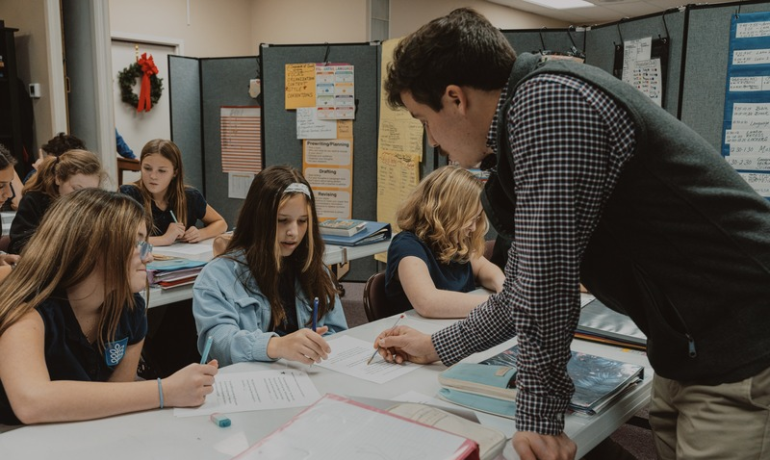
Picture sixteen children gathered around a table for a lesson. Every voice is part of the conversation. A teacher can hear each child read, watch each face when an idea clicks, and notice the student who has gone quiet. In a larger room, a quiet child can go a full week without being called on. With a small class size, that is hard to do.
Learning Gets Personal
Smaller class sizes let teachers adjust in the moment. When a student needs another example, the teacher can offer one. When a classmate is ready for a harder question, the teacher can pose it. Archē’s multi-grade model builds on this flexibility by grouping students according to skill rather than age. A strong third-grade reader can work on fourth-grade material and still stay close to friends who support her socially and emotionally.
That kind of fine-tuning is difficult to sustain with a crowded roster. With a manageable group, it becomes part of the daily rhythm.
Good Discussion Needs Room to Breathe
Classical Christian education leans on Socratic conversation, recitation, and persuasive speaking and writing. Each of these needs a group small enough for everyone to take part. In a class of 16, students practice offering an idea, hearing a respectful challenge, and answering it with care. Quiet children find their voices because they are not lost in a crowd, and confident children learn to listen. Over time, those habits grow into clear thinking and graceful speech, the heart of the Trivium.
The Association of Classical Christian Schools notes that smaller classes help teachers know their students and serve them individually. Students are known by name, by temperament, and by the questions they carry.
Being Known Is the Heart of Discipleship
Archē’s mission is to foster academic excellence and spiritual growth, guiding students toward a life rooted in Christ. Discipleship is relational by nature, and it happens when someone knows a child well enough to encourage, correct, and pray with specifics rather than generalities.
The school day carries this out in simple ways. Each morning, the whole student body gathers for prayer, singing of hymns, and a message. Students study and memorize Scripture regularly. Faculty and staff see themselves as partners with parents in this work. A teacher who hears a child recite a passage of Scripture is also close enough to notice how that child is doing, and that closeness is where mentoring takes root. Even Jesus taught the crowds, yet He invested most deeply in a small circle of twelve.
Community Beyond the Classroom
Small classes pair naturally with Archē’s low-tech environment, which means fewer distractions and more room for creativity and relationships. Children look at one another and at their teachers. Field trips, which serve as hands-on extensions of classroom learning, are easier to manage with a smaller group, and a teacher can talk with every child along the way. Educators, staff, students, parents, and volunteers form a community in which people know one another by name.
What Families Can Expect
For parents, a small class size means that when you ask a teacher how your child is doing, the answer comes from daily observation. Conferences and hallway conversations can be specific, including topics like:
- Where your child is growing.
- Where your child is stretching.
- How you can help at home.
Teachers who know your child well can also celebrate the quiet victories that a grade book never records.
For Friends and Donors of Archē
Keeping classrooms at this size takes teachers, space, and steady support. Every gift helps a school community remain a place where children are known individually and taught with attention. If you have wondered what your generosity looks like in a real classroom, it looks like a teacher with time to listen, a student who feels seen, and a daily culture of faith lived out among friends.
Take the Next Step with Archē Classical Academy
The best way to understand a small class size is to see one. Learn more about our community on the Why Archē page, or explore how Christ shapes every subject on our curriculum page.
Archē Classical Academy is accepting new students. Schedule a tour or request information today, and come see how it feels when your child is known.